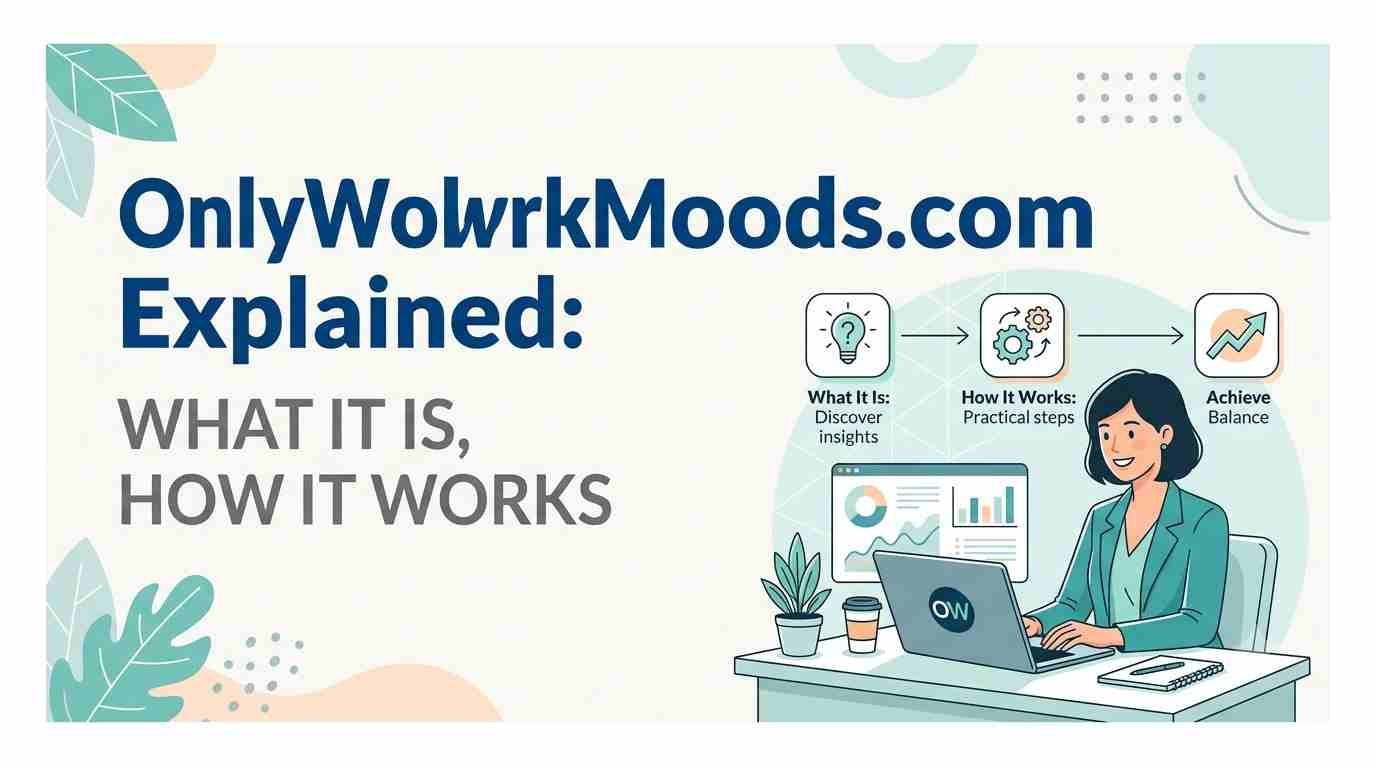
OnlyWorkMoods.com Explained: What It Is, How It Works, Is It Legit, and Everything You Need to Know
Type “onlyworkmoods com” into a search bar and you’ll get a stack of articles that mostly say the same thing. Some call it a productivity tool.
Others hint at mood tracking.
A few just repeat whatever the last article claimed. That leaves you no closer to an actual answer.
So let’s do something different. This piece separates what you can verify from what people are simply guessing based on the name.
By the end, you’ll know exactly what onlyworkmoods com is, who it helps, and whether it deserves a spot in your bookmarks.
What Onlyworkmoods com Actually Is
Here’s the short version: onlyworkmoods com is a content website, not a software tool.
It publishes articles you read. That’s it. No dashboard, no login wall, no app to install.
When you visit, you’ll find blog-style posts sorted into categories. You browse, you click, you read. It works the same way any online magazine does.
The topics lean toward work and career subjects, but the site also stretches into business, tech, finance, and general lifestyle content.
That’s what can be observed directly from the public pages.
Everything beyond that — the mood-tracking features, the employee analytics, the productivity dashboards you might expect — is guesswork drawn from the name. We’ll get into why that matters shortly.
Expectation vs. Reality: Tool or Content Site?
The name does a lot of heavy lifting here, and not in a helpful way.
“OnlyWorkMoods” sounds like an app that logs how you feel at work. Maybe it tracks your energy through the day.
Maybe it surveys your team and spits out sentiment reports. That’s a reasonable assumption before you click.
Then you land on the site and find articles. No check-ins, no charts, no account setup. Just things to read.
Picture a remote worker on a rough Wednesday afternoon. They’ve heard mood-based scheduling can help, so they search “onlyworkmoods com” hoping to find a tool that maps tasks to their energy levels. Instead, they get a blog post explaining the general idea. Useful for background reading, sure. But it’s not the app they were after.
That gap between what people expect and what they find looks like this:
| What People Expect | What They Actually Find |
|---|---|
| A mood-tracking app with logins | A content website with articles |
| Team sentiment dashboards | General workplace reading |
| Downloadable productivity software | Free-to-read blog posts |
| Employee surveys and analytics | No interactive tools |
A domain name doesn’t prove what a service does. Anyone can register a name that sounds like a product without ever building one. And that very mismatch is what fuels the searches — people click precisely because the name promises something the site doesn’t deliver.
What Content It Covers
The site casts a wide net. Its main topic areas include workplace productivity, career development, remote work, business, finance, technology, and everyday lifestyle subjects.
If you found the site through its name, the work and career articles will feel most relevant. Think posts about staying focused, managing your time, or navigating a job change. A young graduate researching how to survive their first office role would find plenty of introductory material here.
Now for the honest part: the coverage is broad, which means the depth is shallow. These articles work as starting points, not final answers. You’ll get the general shape of a topic, not an expert-level breakdown. Quality can also swing from one post to the next, since multi-topic sites rarely maintain the same standard across every subject.
One more thing worth doing — check the publication date. Workplace advice ages fast, especially anything tied to remote work norms or hiring trends. A post from two years ago might reference practices that have already shifted.
Who It’s For
Lumping everyone together as “professionals” isn’t helpful, so let’s break it down by who actually benefits.
Best fit: students, recent graduates, and casual readers who want a quick, plain-language overview of a work topic. If you’re new to a subject and just need the basics explained without jargon, this is a comfortable place to start.
Somewhat useful: freelancers and remote workers hunting for general tips. You might pick up a habit worth testing or a reminder that nudges your routine in a better direction.
Less useful: HR professionals, managers, and anyone facing a high-stakes decision. If you’re building a company policy, handling an employee dispute, or making a career-defining move, general articles won’t cut it. You need specialized, authoritative sources instead.
A general content site shines when the stakes are low and you’re just orienting yourself. It struggles the moment you need precision.
How to Evaluate Its Credibility
Instead of telling you to simply “trust it” or “avoid it,” here’s a framework you can apply to onlyworkmoods com — or any content site you stumble onto.
Look for these trust signals:
- Author information. Is there a real name and relevant background attached to the article, or is it published anonymously?
- Dates. Can you see when it was published or last updated?
- Supporting sources. Do factual claims link to evidence, or are they stated with no backup?
- Transparency pages. Does the site have a clear About page, contact details, and an editorial policy?
- Balance. Does the writing separate fact from opinion, or blur the two?
One quick myth to clear up: seeing HTTPS and a padlock in your browser only means your connection is encrypted. It protects the data traveling between you and the site. It says nothing about whether the article’s content is accurate. A perfectly secure site can still publish shaky advice.
There’s also a difference between legitimate and authoritative. A site can be a real, functioning publication (legitimate) without being an expert source you’d cite for important decisions (authoritative). Onlyworkmoods com can be the former without being the latter.
Finally, a safety warning. If you ever find a page claiming to offer an “onlyworkmoods com login,” an employee portal, or an app download, treat it with suspicion. Since the public site is built for reading, not accounts, any page asking for credentials or pushing a download deserves a hard look before you enter anything.
What’s Verified vs. What’s Assumed
This is the heart of the whole review, so let’s make it count. Here’s the clean split between what you can confirm from the site and what people simply assume because of the name:
| Verified From the Site | Assumed From the Name |
|---|---|
| It’s an article-based publication | It’s a mood-tracking platform |
| Free public reading | It has employee analytics |
| Covers multiple topic categories | It has a login/dashboard |
| Standard legal and About pages | It offers a mobile app |
Here’s how the confusion snowballs. One writer sees the name, assumes it’s a mood-tracking app, and describes those features as if they exist. The next writer reads that article, repeats the claim, and adds a detail or two. Before long, half the search results describe an app that was never there. Nobody checked the actual site — they just copied the story.
You can spot this pattern yourself. When several articles use nearly identical phrasing, list the same imaginary “features,” or describe dashboards without a single screenshot, that’s recycled speculation, not observation. Trust the pages that describe what’s genuinely visible on the site over the ones that describe what the name suggests.
How It Compares to Other Workplace Resources
Putting onlyworkmoods com next to its neighbors makes its role clearer. Here’s how it stacks up against a focused career blog and an actual productivity app:
| Feature | Onlyworkmoods com | Niche Career Blog | Productivity App |
|---|---|---|---|
| Format | Multi-topic articles | Focused articles | Interactive tools |
| Depth | Broad, introductory | Deeper, specialized | N/A |
| Best use | Quick overviews | Skill-building | Task/mood tracking |
| Cost | Free reading | Often free | Often paid |
The tradeoff is easy to see. Onlyworkmoods com wins on breadth and accessibility — free, easy to read, and covering lots of ground. It loses on depth and function. A niche career blog run by a specialist will teach you more about one subject. And if you genuinely want to track your moods and match tasks to your energy, you need an actual app with logging and reminders, not a website explaining the concept.
Match the resource to the job. Reading for orientation? The content site is fine. Building a real skill or tracking real data? Look elsewhere.
Who Should Use It and Who Should Skip It
Let’s make this simple.
Use it if you want a fast, plain-language starting point on a work or career topic. It’s a decent first stop when you’re curious about something and don’t need much depth. A college grad skimming tips before their first day at an office job would get real value here.
Skip it if you’re making decisions that carry weight — legal questions, financial planning, HR policy, or a major career move. For those, general articles are too thin. Go to specialized, credentialed sources instead.
And for anything that matters, pair whatever you read with a second source. One general article should never be your only input on an important call.
Final Verdict: Content Site, Curiosity, or Real Resource?
Onlyworkmoods com is a functioning informational website. It publishes articles across work, career, business, tech, and lifestyle topics, and you can read them for free without an account. That’s the reality.
What it is not: a mood-tracking tool, a productivity dashboard, or an employee analytics platform. Those ideas come from the name, not the site. The expectation-vs-reality gap is the whole story here — people arrive expecting software and find a blog.
Treat it as one source among many, not a final authority. If a topic actually matters to you, verify the claims elsewhere and match the site to what you genuinely need. Used that way, it’s a harmless, occasionally handy place to start — and nothing more.
FAQs
Is onlyworkmoods com a mood-tracking app?
No. It’s an article-based content website. There’s no evidence of mood logging, energy tracking, or any interactive tool — that expectation comes from the name.
Does it require a login?
No. The public articles are free to read without an account. Be wary of any page claiming to offer a login or portal.
Is there an official mobile app?
No official app has been identified. Don’t install anything using the brand name unless it’s clearly linked from the official site and you’ve verified the developer.
Is onlyworkmoods com safe to visit?
Browsing it works like reading any content site — no downloads or accounts needed for ordinary reading. Still, apply normal caution: confirm the correct address and never enter passwords or payment details on unverified pages.
Is it legit?
It appears to be a genuine, operating publication with standard About, contact, and legal pages. Legit doesn’t mean authoritative, though — judge each article on its own merits.
What topics does it cover?
Workplace productivity, career development, remote work, business, finance, technology, and general lifestyle subjects.
Who benefits most from it?
Students, recent graduates, and casual readers wanting quick overviews. It’s less suited to HR pros, managers, or anyone needing expert-level guidance for high-stakes decisions.